The Monroe Doctrine in 2025
December 2025 Imperfect Union
Hi friends, a couple of logistics before we dive in. First, I’ll be doing a Substack live with In Pursuit on January 5 at 7:30 PM in honor of the 250th anniversary of Common Sense. Feel free to join us or catch up later.
Second, in a couple of months, I will hit seven years of writing monthly. There are many more faces here than when I started and I’m guessing most of you haven’t seen all of the back catalog. I thought it might be fun to share some of the better posts from the early days, as many are still relevant or at least educational. My plan would be to share one of those, often with a new introduction, around the 1st of every month, and then share new content on the 15th like usual. Sometimes, I might be inspired to write two new posts per month—maybe one focused on my research and one more focused on contemporary issues? I’d love to know your thoughts. A quick poll or feel free to drop a comment below. Thank you!
Back to our regularly scheduled programming. In 1986, Congress passed the Goldwater-Nichols Department of Defense Reorganization Act of 1986 (Public Law 99-433). Section 603 requires each presidential administration to publish a National Security Strategy. Last week, President Trump released his NSS and it included this passage:
“After years of neglect, the United States will reassert and enforce the Monroe Doctrine to restore American preeminence in the Western Hemisphere, and to protect our homeland and our access to key geographies throughout the region. We will deny non-Hemispheric competitors the ability to position forces or other threatening capabilities, or to own or control strategically vital assets, in our Hemisphere. This “Trump Corollary” to the Monroe Doctrine is a common-sense and potent restoration of American power and priorities, consistent with American security interests.”
I thought it might be useful to explain the history of the Monroe Doctrine, what it actually meant in 1823 when John Quincy Adams wrote it, and how it has evolved since then. This material is also central to one of the chapters in my new, in-progress book on John Quincy Adams, so it is interesting (fun? weird? confusing? nerve-racking?) to see it so relevant today.
In the late 1810s and early 1820s, Colombia, Brazil, Chile, Ecuador, Venezuela, and Mexico had declared independence, and Cuba and Puerto Rico appeared to be following in their wake. Meanwhile, in Europe, conservative authoritarians were on the march. In the wake of Emperor Napoleon’s final defeat and banishment, Tsar Alexander I had formed the Holy Alliance between Russia, Prussia, and Austria to support the principles of divine monarchy and their shared religiosity, to bully other European monarchs into submission, and to crush rebellions. They demonstrated this commitment by backing the unpopular Bourbon kings, Louis XVIII and Charles X, and dispatching a military force to Spain to restore King Ferdinand VII to absolute rule.
Rumors swirled in Washington, D.C that the Alliance forces were posed to move on Latin America and restore Spanish colonial rule. In response, Britain extended an offer to President Monroe, through correspondence with John Quincy Adams, to join forces to keep the Holy Alliance at bay. The British fleet did a brisk trade with South American nations and did not particularly want Russian or French fleets interfering in their business.
Russian aggression and a potential British alliance posed three interconnected questions. First, should Americans come to the aid of their sister revolutionaries in Europe or Latin America? Second, how should the government respond to European territorial aggression? Third, should the United States respond in concert with Great Britain, which had its own economic interests to defend in South America?
Adams crafted a three-piece plan that brushed back Russian meddling, forbade European interference, kept British forces at bay, and protected the United States from entangling itself in costly and messy wars. The first piece was an official letter to Russia, laying out the clash between the two nation’s fundamental principles. Adams wrote, the “United States recognize in other Nations the right which they claim and exercise for themselves, of establishing and of modifying their own Governments, according to their own judgments, and views of their own interests, not encroaching upon the rights of others.” This world view offered a sharp contrast to the force and intimidation imposed by Russia. Adams also insisted the United States hoped to maintain friendly relations with all nations, including Russia, but he was drawing a firm ideological line between republics and autocracies.
The second piece was a response to the British offer to collaborate. Adams deftly sidestepped the issue, responding that the United States had already recognized the independence of the South American republics; until Britain did so, no collaboration on equal footing would be possible. He encouraged both nations to put forward their objections to European interference, but to do so separately.
The final piece was the president’s annual address to Congress. Adams drafted the portions of the address that proclaimed that the United States would oppose any European attempts to resubjugate their former colonies. Nor would Americans permit any future European attempts to colonize territory in the Western Hemisphere. In return, the United States would stay out of European affairs.
The President’s Address is known as the Monroe Doctrine, but there are two important caveats. 1) The actual Monroe Doctrine combined all three pieces or it would have had much less impact 2) It was John Quincy Adams’s creation. President Monroe had been exchanging letters with Thomas Jefferson and James Madison about the British offer to cooperate and they had encouraged Monroe to accept British help. While debating the subject in a cabinet meeting, Adams insisted,
“It would be more candid as well as more dignified to avow our principles explicitly to Russia and France, than to come in as a Cock-boat in the wake of the British man of War.”
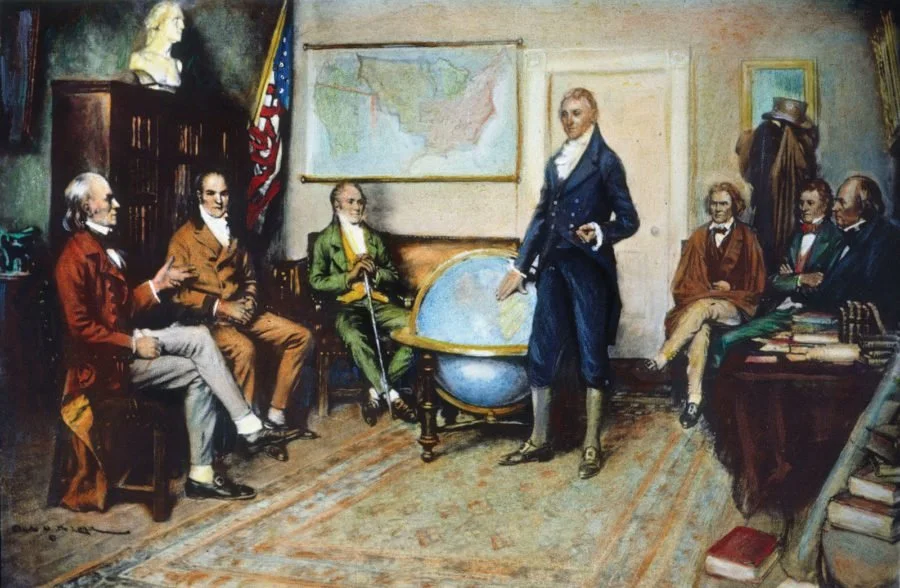
President James Monroe and his cabinet. Courtesy of James Monroe’s Highland.
So what did it mean at the time? Frankly, very little. The United States had a tiny baby navy and a tiny baby army and little power with which to enforce this mighty doctrine. French and Russian failures in Europe partially explain why the Monroe Doctrine was not tested in the coming years. Most importantly, however, the British navy basically enforced it because it suited their own interests to do so.
For today’s purposes, it is important to know that Adams was mostly concerned about hard power—armies on the ground and navies in the waters off the coast of the United States. Adams and his contemporaries were much less concerned about trade and economic influence. They wanted to partake in widespread global trade, so permissive trade policies served their interests. They also didn’t view trade as a zero sum game. They did not see European trade in South America as reducing American influence and therefore, a threat to American security.
Which is not to say that nineteenth-century Americans ignored the relationship between military security and trade policy. Economic leverage as a military tool was the theory behind the Embargo of 1807 (which was a complete failure) or the Confederacy’s expectation that Britain would join their side to secure the cotton trade.
Instead, American economic interests in South America were still relatively small as part of the global percentage and thus, were not materially harmed by other nations participating in trade. This explanation is a bit of an oversimplification, but hopefully you get the idea.
They were also focused on the type of governments in their backyard. Adams believed that republics shared values and shared values made the best allies. If the United States had possessed the military might to enforce the Monroe Doctrine, it was mostly a defensive document. He wanted to protect the emerging republics in South and Central America as potential allies, but not intervene to enforce republicanism in other nations. As I read it, based on John Quincy’s intent, the Monroe Doctrine was not an imperial or war-mongering document.
Which is a bit ironic, because it ushered in the century of American imperialism. Over the next several decades, the United States acquired vast territories across the south, southwest, and eventually northwest of the modern United States. Furthermore, by the end of the century, American attitudes toward the Western Hemisphere and European Empires had acquired a bullying belligerence.
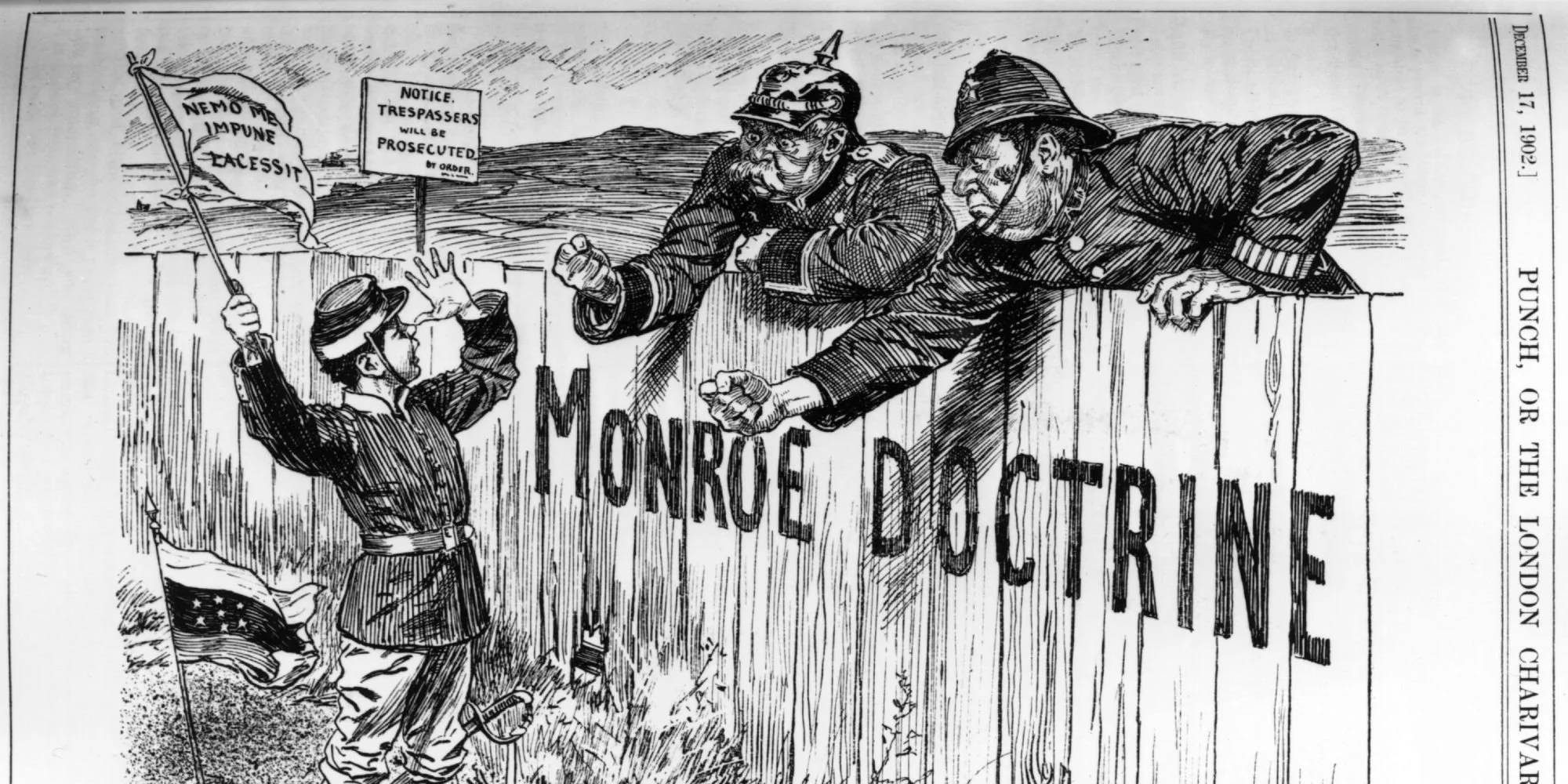
In Theodore Roosevelt’s December 1904 Annual Address to Congress, he added the Roosevelt Corollary:
“In the Western Hemisphere the adherence of the United States to the Monroe Doctrine may force the United States, however reluctantly, in flagrant cases of such wrongdoing or impotence, to the exercise of an international police power.”
In other words, the Western Hemisphere was still closed to colonization by European powers, but the U.S. might be required to intervene to protect lives and property, and preserve order in its proverbial backyard. The corollary was much less an addendum than a different approach masked as an adjust.
This mentality fueled TR’s acquisition/takeover of the Panama Canal in 1903 with the justification that it was too important to the American economy to leave to another nation to manage poorly.
Because I am not a practitioner of foreign policy in the twenty-first century, I will leave my remarks there. But if you’d like to read or listen to experts analyze the NSS, here are a few suggestions:
Lawfare Livestream on National Security Strategy
Kori Schake for Foreign Policy