The Four Factors George Washington Used to Grant Pardons
September 2026 Imperfect Union
As I’ve traveled around the country this year, I regularly get asked about what gives me cause for optimism. History tells us that moments of upheaval, like this one, often produce widespread reform and I think we are looking at enormous opportunity for much-needed reform. There is actually widespread appetite for several reforms on both sides of the political aisle, including legislation that bans stock trading in Congress, term limits and ethics reform for the Supreme Court, and executive war powers. There is also deep support for reform of the president’s pardon power.
The Constitution says that the president “shall have Power to grant Reprieves and Pardons for Offences against the United States, except in Cases of Impeachment.” This language is unlike many other powers granted in the Constitution. The language is fairly absolute and the pardon power is one of the president’s most unlimited. The courts have largely rejected attempts to limit this power. And yet, the time has come to address this constitutional blind spot.
I heard from a friend the other day, who teaches The Cabinet in one of her classes. Her students were curious about George Washington’s use of the pardon power. She wanted to know if I had written anything about the subject or if I knew of anything she could share with the class. A cursory glance didn’t turn up anything and I decided to write this dispatch to answer the question. I thought it would be helpful to fold into the conversation about pardon reform because I think Washington’s principles offer a valuable guide for potential legislation.
George Washington issued 16 pardons that offered a powerful example to his successors. His pardons are also not well understood. The majority of Washington’s pardons concerned the Whiskey Rebellion in 1794. But they were not his first pardons. I repeat, THEY WERE NOT HIS FIRST PARDONS. That misinformation is everywhere on the internet. To be fair, they were the first pardons for treason, but not the first overall.
The earlier pardons occurred in the spring of 1794 and largely focused on economic misdeeds. Here is a picture of one of Washington’s first pardons for David Blair. Blair captained a merchant ship owned by John Berrien, which brought in “two casks of rum of less capacity than fifty Gallons each contrary to the act of Congress.” The ship and rum were seized, and Blair was convicted in the District of Georgia.
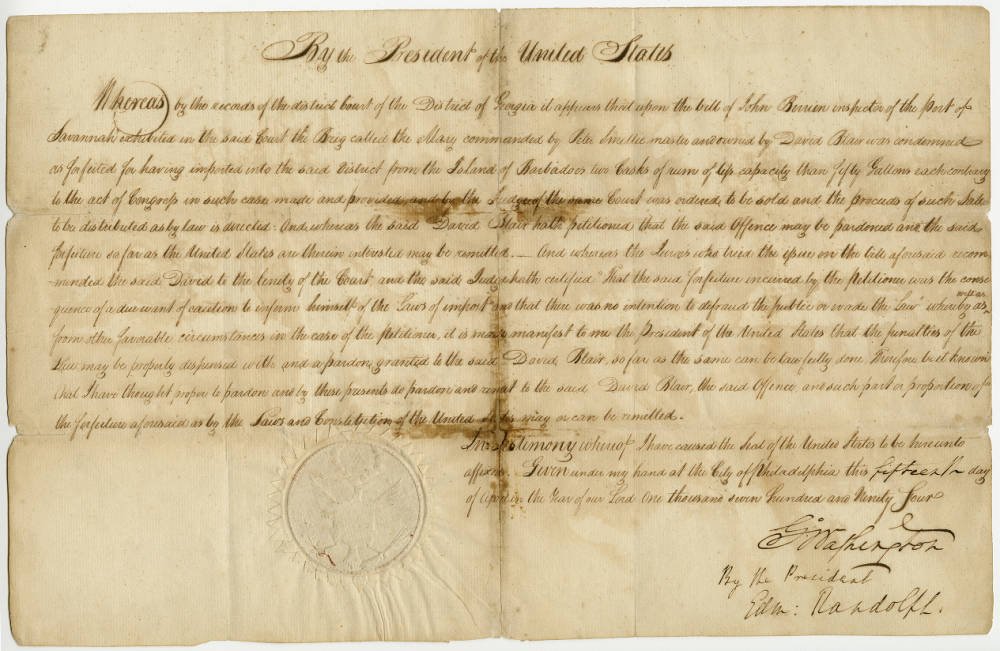
Presidential Pardon, issued by George Washington to David Blair, 1794 April 15. Special Collections, George Washington Presidential Library at Mount Vernon, Mount Vernon Ladies Association.
Later that year, the Whiskey Rebellion broke out and prompted Washington to think about pardons for more serious crimes. Just a quick reminder, in 1791, Congress passed a Whiskey Excise Tax, which hit western regions particularly hard because those regions tended to distill their excess corn and grain at higher rates. Whiskey was more shelf stable, easier to transport, and easier to barter than grain, and these regions were far from the Atlantic coast ports. They didn’t yet have reliable access to the Mississippi River for trade, so everything had to go over the mountains to market.
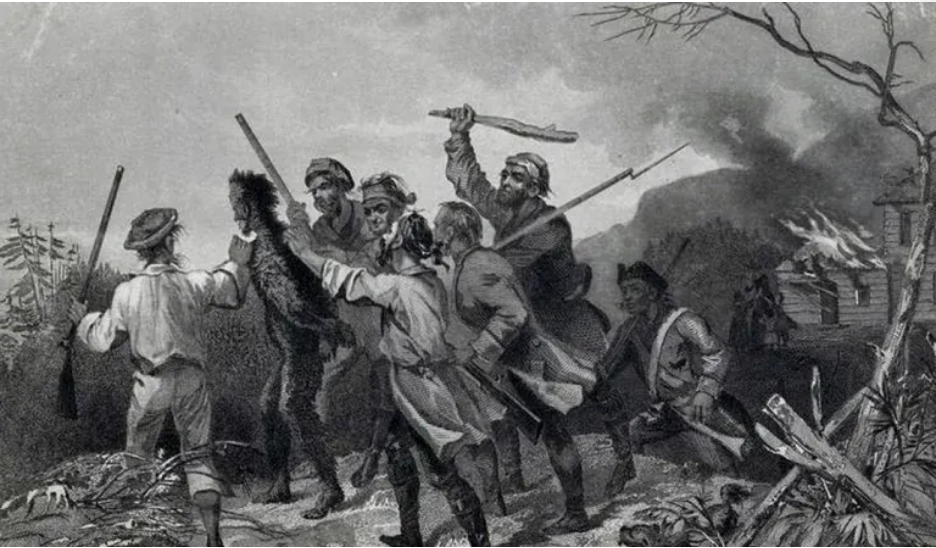
The resistance started peacefully: a series of protests, petitions, meetings, etc. In the spring of 1794, the resistance in western Pennsylvania turned violent when rebels burned down the house of a tax collector and exchanged gunfire with federal officials. Washington gathered his cabinet and they quickly decided to invoke the recently passed militia act, which permitted the president to call up the militia in the event of a foreign invasion or domestic insurrection, when Congress was out of session, and only after submitting evidence to a Supreme Court justice that this step was necessary. After one last attempt at diplomacy, Washington summoned the militias of five states and marched west to meet them in Carlisle, Pennsylvania. He reviewed the militias, then turned around and rode back to Philadelphia.
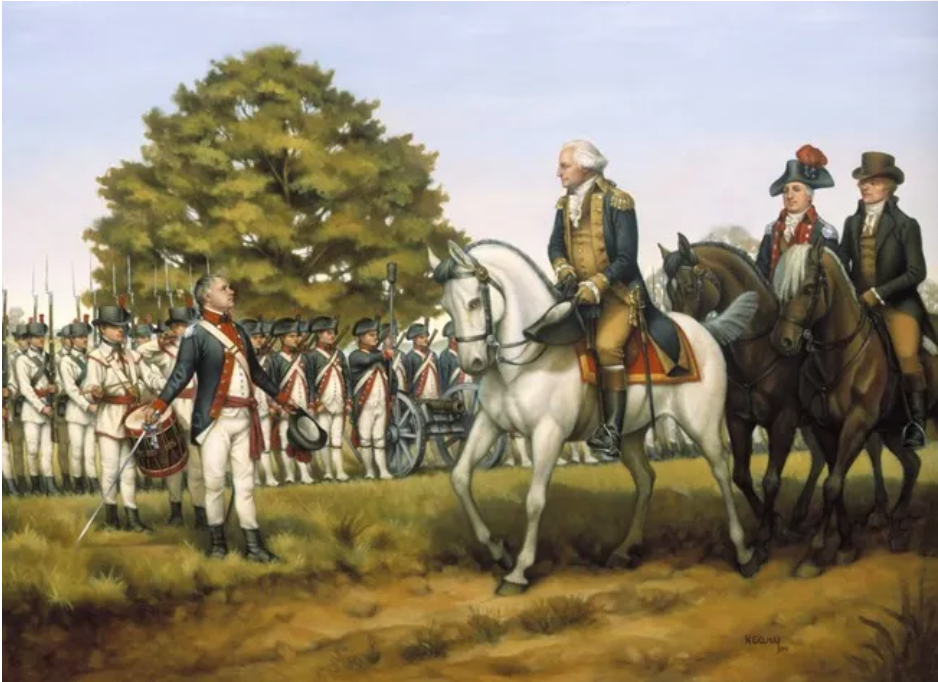
Courtesy of NPS. Note: I’m pretty sure he wasn’t wearing a uniform.
Washington left the forces under the command of Alexander Hamilton and “Light Horse Harry” Lee. They rounded up all the rebels they could find, though most dispersed when met with federal resistance. 150 rioters were arrested, but only 24 were charged for high treason. Of the 24 cases, only 10 made it to trial. John Mitchell and Philip Vigol (sometimes also spelled Weigel) were convicted and sentenced to death. The state court in Pennsylvania did convict more rioters for assault and destruction of property.
Washington kept a careful eye on the cases and monitored their progress. In the fall of 1794, Washington began to receive letters and petitions on behalf of Mitchell and Vigol. Daniel Morgan, one of the commanders of the forces in western Pennsylvania, wrote that Mitchell had been “led astray, weak—ignorant and unthinking.” He recommended Washington consider Mitchell as “an object of mercy” because “A Wife and several children depend for subsistence upon his labor alone. Deprived of his aid they must be reduced to poverty—perhaps to misery.” Washington forwarded Morgan’s letter to Attorney General William Bradford and asked for his input. Bradford suggested “that no pardon should be granted before Trial & that some benefit will result from the Conviction of a person guilty of this offence altho’ he should afterwards receive the mercy he asks.” Washington agreed with Bradford and waited for the outcome of the trial.
After all the cases had completed, Washington issued a proclamation of amnesty for the insurgents convicted of lesser charges. The proclamation did not apply to Vigol and Mitchell, who had been convicted of treason. In June 1795, the jury that heard Mitchell’s case sent Washington a petition urging him to consider Mitchell “a proper Object of Mercy.” That might seem like an odd thing for the jury to do after they had just finished convicting him of treason. But the courts of the 1790s did not offer the same protections for defendants and judges often stacked the deck almost guaranteeing the jury had to return a guilty verdict.
On June 16, Washington issued a stay of execution for Philip Vigol—just twenty-four hours before he was scheduled to be hanged. The next day, he extended a similar stay for John Mitchell. On November 2, 1795, he issued pardons for both men.
Washington’s pardons of Blair and the whiskey rebels suggest that there were four factors that he considered when contemplating clemency. First, he considered whether the petitioners had lived a reputable life prior to the conviction. Was this case a one-off or were they problematic citizens? Most of the people Washington pardoned, including Blair, were veterans of the Revolutionary War. Second, Washington considered whether the conviction would prevent the petitioner from making a living or providing for their family. Third, Washington required the petitioners to take responsibility for their actions. Fourth, Washington expected the petitions to swear loyalty to the Constitution if the charges called into question their patriotism.
I should specify that Washington never wrote a single letter outlining these four factors (history would be much easier if he did write down his thoughts in such articulate fashion). Instead, we can see what mattered to him through a series of letters and questions about the potential pardons.
A few years later, Adams followed Washington’s example when he pardoned the rebels convicted in the Fries’ Rebellion. I wrote about his decision at some length in Making the Presidency, but mostly Adams followed Washington’s example. He considered the defendants’ personal histories and valued their experience as military veterans, just as Washington had done. He worried about the harsh punishments for relatively mild actions and the legal precedent it would establish. And he noted that Washington had made similar decisions. However, in one key factor, Adams deviated from Washington. Adams granted the pardons without his cabinet’s support, while Washington’s cabinet backed his decision. History has largely approved Adams’s decision.
In the last several decades, the pardon process has gone awry. To be sure, some pardons still speak to unjust convictions or address systemic inequities. But presidents of both parties have issued pardons for more sordid reasons. They have pardoned political cronies, friends, and family members. While this problem is a bipartisan one, the sheer scale of pardons in the last two years, including for violent convicted felons, have emphasized the urgent need for reform.
There is ample evidence that democratic systems work with more limited pardon power. We are the only democracy with such unfettered pardon power and most of our states entrust committees with the enormous responsibility to grant pardons or clemency. Historically speaking, it is also a bit odd that we retained this critical element of the monarchy. In the eighteenth century, the British king retained a pardon power, largely because the judicial system was not really independent. Additionally, the king’s pardon power was consistent with the tradition of complete authority of divine right.
How to fix this problem then? A constitutional amendment is the most thorough solution, though that would be difficult to gain the requisite congressional and state support. Various bills have sought to limit the “who,” “what,” “when,” and “how” of pardons. Proposed legislation has excluded the president and his family from pardons, limited the types of actions that can be pardoned, and attempted to eliminate the “midnight” pardons right before a president leaves office. The “how” reforms have introduced a constitutional or independent check on presidential pardon by requiring a congressional vote or review from an independent board—which is how most states handle their pardons.
Other reforms might be easier to pass. In January 2025, Senator Richard Blumenthal proposed a transparency act that would require the administration to publish a written explanation for any pardon. Other bills have required the Department of Justice to submit records for all presidential pardons. And of course, Congress could always practice oversight. Congress could raise awareness of misdeeds and the incentives for questionable pardons. Admittedly, these measures are largely focused on deterrence and require a certain level of shame in public officials. But they are better than nothing and more importantly, might build further public support for a constitutional amendment.
Finally, we have a role to play. We can demand that presidents consider Washington’s four factors and hold them accountable if they issue pardons that deviate from these reasonable qualifications.
How would you suggest we fix the pardon power?